
Your website can be more than a destination. The right system changes what's possible.
Smart automations turn your site into an active part of how your business runs — unlocking opportunities you didn't know you were missing.
Let's talkWhat this actually looks like
Not a gimmick. Not a flashy demo that doesn't survive contact with real business operations.
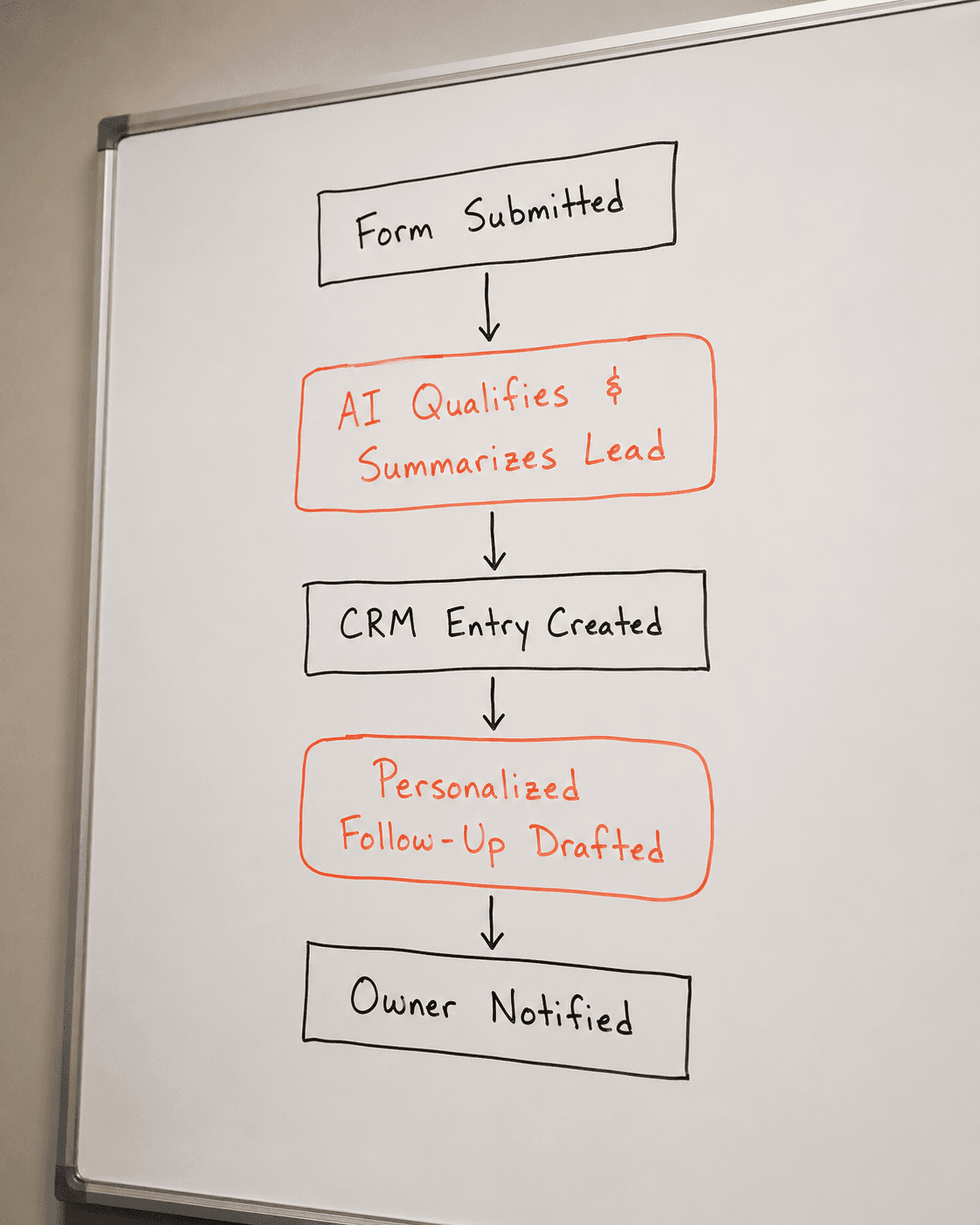
Real automation looks like this: a lead fills out a form and the right person gets notified immediately — with context, not just a name and email. A new inquiry gets an instant, intelligent response while you're in a meeting. A booking, a question, a follow-up — handled the moment it arrives, routed correctly, logged where it needs to go.
The gap between “someone contacted us” and “we responded well” gets a lot smaller. Fast.
What's possible
Inquiries captured, categorized, and routed the moment they come in. Nothing sits in a submission inbox waiting for someone to check it.
Responses that go out fast and feel considered. The first touchpoint sets the tone for the relationship.
Information collected on your site moves directly into the tools your business already uses. No manual transfer, no dropped context.
The right alert gets to the right person, automatically, based on what the site receives.
Appointments booked, intake forms completed, confirmations sent — before you've opened your laptop.
These are examples, not a menu. The automations that make sense for your business depend on how your business actually works — and that's a conversation worth having.
Part of a smarter site
Automation is most powerful when it's woven into how the site works from the beginning — not added as an afterthought.
The sites nimblefish builds are architected with this in mind. Designed to get smarter over time, as your business is ready. What starts as a high-performing website evolves into something that handles more of the operational work your team currently does by hand.
We're already building toward a future where updating your site is as simple as chatting with it. The builds we do today are designed to get there.
Let's talkIf your business has a problem, we want to hear about it.
Every automation on this page started as a frustration someone described out loud. A step that took too long. A lead that went cold. A process that worked fine at ten clients and fell apart at thirty.
If something in your operations is creating drag — and you're not sure if it's fixable — that's exactly the kind of conversation we want to have. Not every problem has an automated solution. You might be surprised what's actually solvable.
The process was incredibly structured, making it easy to follow along and provide input and content. Ash is professional, attentive, and truly dedicated to delivering a high-quality website.

When does automation make sense?
When there's a real operational friction — something your business handles repeatedly, manually, between your website and the rest of your operations — automation earns its place.
When there isn't, we won't recommend it.
That's not a hedge. It's how we think about every tool we bring to an engagement. The right recommendation comes from understanding your business first — not from having a capability to sell.
Let's talkA few questions we hear often.
How does nimblefish decide whether to recommend automation?
It comes out of the conversation about your business. If there's a workflow creating friction — leads falling through the cracks, manual steps that eat time, gaps between your website and your operations — that's where automation earns its place.
Do I need a nimblefish-built site to add automation?
Not necessarily. Some automations work beautifully with an existing site. Others are better designed in from the start. The right answer depends on what you have and what you're trying to do — worth a conversation before any decisions get made.
What does adding automation actually involve?
It depends on the scope. Some workflows connect quickly and cleanly. Others take more setup. What stays consistent is the approach: understand the problem first, recommend only what genuinely solves it, and build it to work reliably — not just impressively.
Let's talk