Skip to content

esther.ai · Digital risk and accessibility

It had to pass
its own test.

esther.ai builds the record of an organization's accessibility, over time. So its own website had to hold up to the same record, from the day it went live.

The esther.ai home page: on a near-black background, the headline "Digital risk, measured and documented over time," with "Esther finds. Esther ranks. Esther records." below.
Client
esther.ai
Who it serves
Municipalities and institutions
Live
October 1, 2026
Built to
WCAG 2.2 AA
See it
esther.ai

At a glance

86

success criteria in WCAG 2.2, the standard Esther's record is built on.

Esther experiences a website as closely as it can to the way a person does, reads it against those criteria, and keeps every result with its date. Human experts review the findings, again and again, as the record grows.

The win: the company that builds an organization's accessibility record over time has a website held to that same record, and one that keeps adding to it every week.

The challenge

No room for "almost"

  • Esther creates the record of an organization's compliance state, over time: what was found, how much it matters, and what has changed since, each with its date.
  • It serves city halls and counties, and institutions from campuses to banks. It measures cybersecurity risk the same way.
  • Its buyers answer to counsel, and many will read the site before they ever call.
  • The site had to be accessible, true to the record on every page, and plain enough for a city clerk to read in one sitting.

The difference

A record, not a scan

  • A scanner reports what's wrong on the day it runs.
  • An overlay adds a widget and promises the rest. The Federal Trade Commission ordered one overlay company to pay $1,000,000, and barred it from claiming, without evidence, that its product could make any website compliant.
  • Esther builds the record over time. It uses a website as closely as it can to the way a person does, ranks every finding by what it stops someone from doing, and has human experts review the findings as the record grows.

The overlay order is on esther.ai's Precedent page, with its docket number.

How we got there

Five decisions that shaped the site

01

Check the live site by hand on launch day

The decision

The day esther.ai went live, we checked every page of the real site at phone, tablet and desktop sizes.

Why

A scan catches some problems. A person has to check the rest: using only a keyboard, zooming in, and spacing the text out.

What it led to

No violations in 51 automated scans, every page walked by keyboard, and every check written down with its date.

02

Read every case at its source

The decision

Every settlement, order and regulation on the site was read in the document itself: the agreement, the court filing, the rule. Never a summary of it.

Why

esther.ai talks to people who answer to lawyers. One wrong date would cost more trust than any page could earn back.

What it led to

Each case on the site carries its court or docket number, so a reader can check it for themselves.

03

Make the record the picture

The decision

The images are the record: excerpts quoted from agreements, findings tables, and views built from what Esther measures.

Why

Esther's work is a record that holds up. Showing that record says more than a photograph could.

What it led to

Pages a buyer can scan in a minute: what was required, by when, and where the risk sits.

04

Let every line point to its proof

The decision

Every statement on the site rests on something a reader can check: an agreement, a court filing, a dated finding.

Why

A record is only worth what it can show. The website is the first record a buyer reads.

What it led to

A site that reads like a record: dates, figures and sources, side by side.

05

Train the voice, and keep training it

The decision

Brand voice training with both founders, from the first draft on, written into a voice guide that keeps evolving.

Why

Esther speaks to clerks, counsel and boards. It has to sound like the people who stand behind the record.

What it led to

One voice across every page and every article, whoever drafts it.

esther.ai
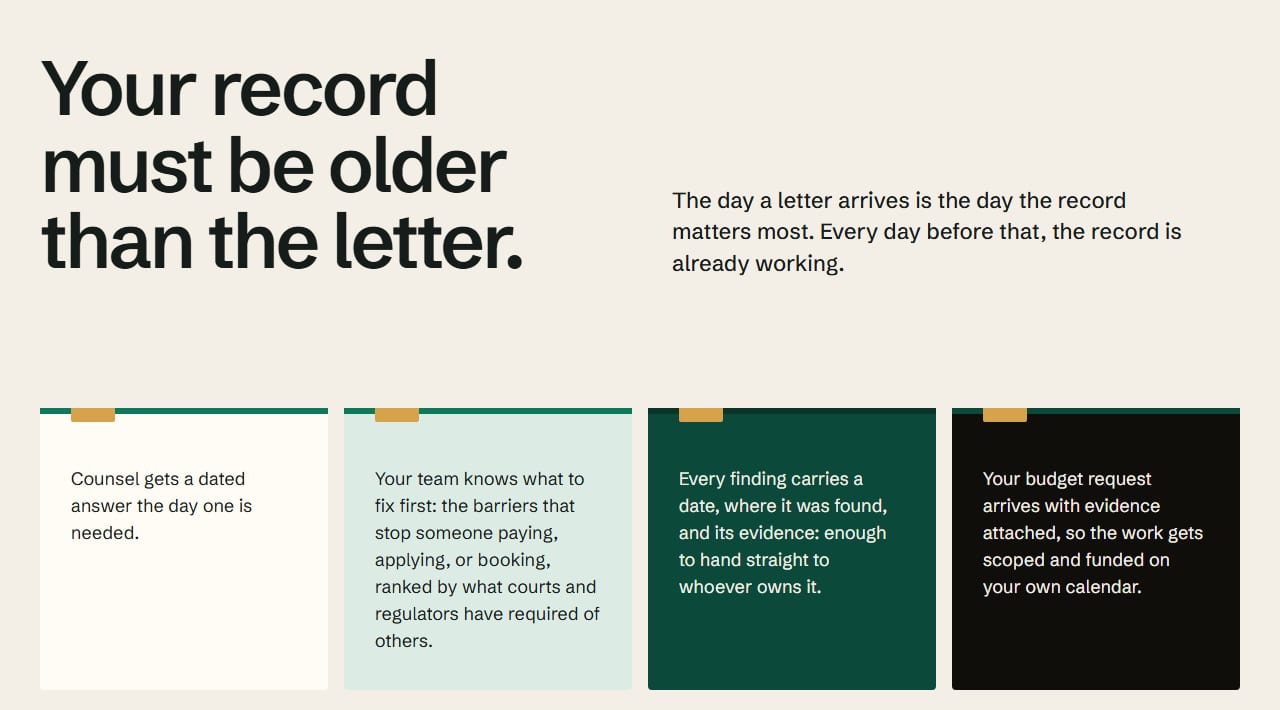
A section of the esther.ai home page: the heading "Your record must be older than the letter," the line "The day a letter arrives is the day the record matters most. Every day before that, the record is already working," and four cards on what a dated record gives counsel, the team and the budget.
The esther.ai home page on a phone, the headline set large on a near-black background.
Over time, in esther.ai's own words: the record has to exist before anyone asks for it.

Inside the site

Built like the record it keeps

Three threads run through the site, and each one can be checked.

The precedent

What other organizations were required to do

Two public universities, a city, a transit district, a state agency and a county, each on the Precedent page.

  • Each case is a card: what was at issue, what was required, and by when.
  • The requirement is quoted from the agreement, not paraphrased.
  • The headline is the deadline or the cost, in a few words: Six months, vendors included.
  • The docket number sits at the foot of every card.
A card on esther.ai's Precedent page: Settlement agreement, January 2018, "Six months, vendors included," with what was at issue and what was required of Denver, and the DJ number at the foot.
One case from the Precedent page, with its docket number.

The findings

Ranked by what they stop people from doing

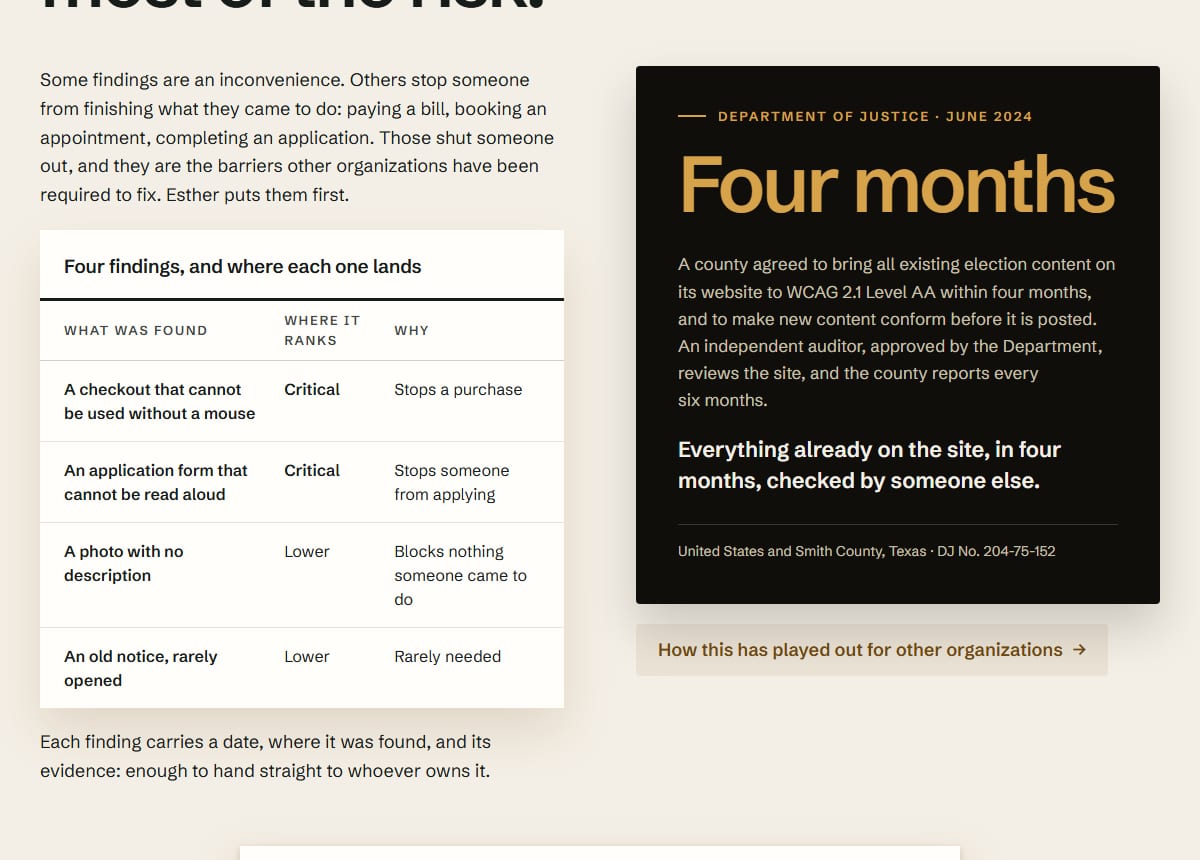
Some barriers are an inconvenience. Others stop someone from paying a bill or applying for a job.

  • The Intelligence page shows how Esther ranks what it finds, in a table anyone can read.
  • Beside it, the deadline another organization was given, quoted from the Department of Justice.
  • Every finding carries a date, where it was found and its evidence, so the record shows what changed over time.
The Intelligence page: a table of four findings with where each ranks and why, beside a card reading "Four months" from a Department of Justice settlement.
Four findings and where each lands, beside a real deadline.

The articles

A site that keeps publishing

Launch was the start. esther.ai now publishes what Esther sees, as it happens.

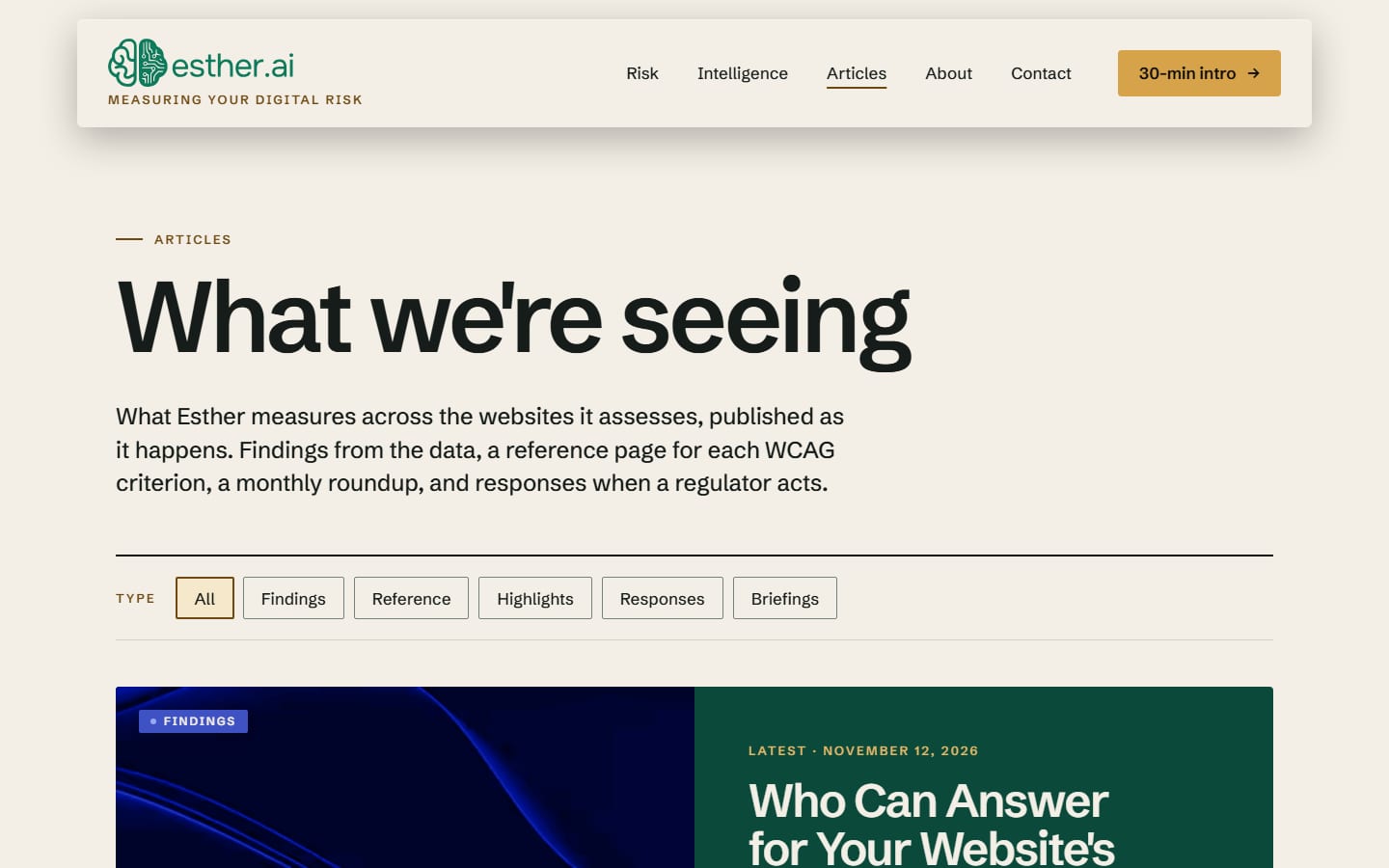
  • Five kinds of article: findings from the data, reference pages, roundups, responses and briefings, each with its own color.
  • Articles are written ahead and go live on their date by themselves.
  • Every article ships with its own share images and posts for each founder's LinkedIn.
  • Each one gets a permanent ID, so nothing is lost as the list grows.
esther.ai/articles
esther.ai's Articles page, "What we're seeing," with filters for Findings, Reference, Highlights, Responses and Briefings, and the latest article featured.
The Articles page, filtered by kind.

What's next

Held to the same standard, every week

  • New articles keep arriving on their dates, each checked against its source before it goes up.
  • New pages are built and checked the same way as the first ones.
  • The voice keeps growing with every round of training.
  • We keep the site current and secure, month after month.

Ash Harris, who founded nimblefish, is a partner in esther.ai.

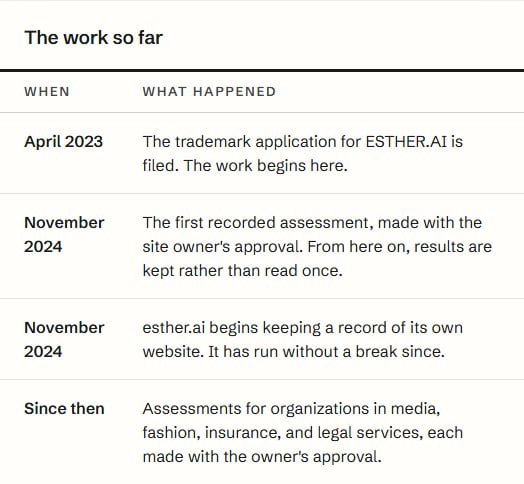
The work so far, from esther.ai's Roadmap page: April 2023, the trademark application is filed; November 2024, the first recorded assessment, made with the site owner's approval; November 2024, esther.ai begins keeping a record of its own website, which has run without a break since; since then, assessments for organizations in media, fashion, insurance and legal services.
From the Roadmap page: a record kept without a break since November 2024.
I think it is perfect. It almost feels like a newspaper. Rick Hensbergen, founder and CEO, esther.ai

Common questions

What owners ask us about this

Can a website accessibility checker tell me my site is accessible?

No. An automated checker catches part of what WCAG asks, on the day it runs. The rest, like using only a keyboard, zooming in and hearing a page through a screen reader, has to be checked the way a person uses the site. We do both on every site, and write it all down. Here's how we approach accessibility.

Will an accessibility overlay make my website compliant?

A widget can't fix the website underneath it. The Federal Trade Commission ordered one overlay company to pay $1,000,000 and barred it from claiming, without evidence, that its product could make any website compliant. The barriers get fixed in the site itself, and the work is kept on record. See what we build to.

What should an accessibility statement say?

The standard you work to, how someone can tell you about a problem, and that you keep working on it. Say only what you can show. See how we approach accessibility.

Can my website publish articles on a schedule?

Yes. Articles can be written ahead and set to go live on a chosen date and time, with no one needing to press publish. It's how a small team keeps a steady voice in search and AI answers. More on getting found in search and AI.

Your website should hold up when someone checks.

Let's talk about what yours needs. Here's how we approach accessibility.

Start a conversation

more catches

More catches

Two more stories of the sites we've built, and the people who run them.