

Your Google ranking changes by location because map results are built around the person searching, not around your business. The same search can return a different list two miles apart. A business can sit 6th from one spot and not show up at all from the next town over.
The easiest way to see it is on a map.
One search, 49 spots
Picture a roofing company with its shop near downtown Lansing. Now run one search, "roof repair," on Google Maps from 49 spots around the city, on a grid with 2.5 miles between each spot. Same words every time. The only thing that changes is where the search comes from.
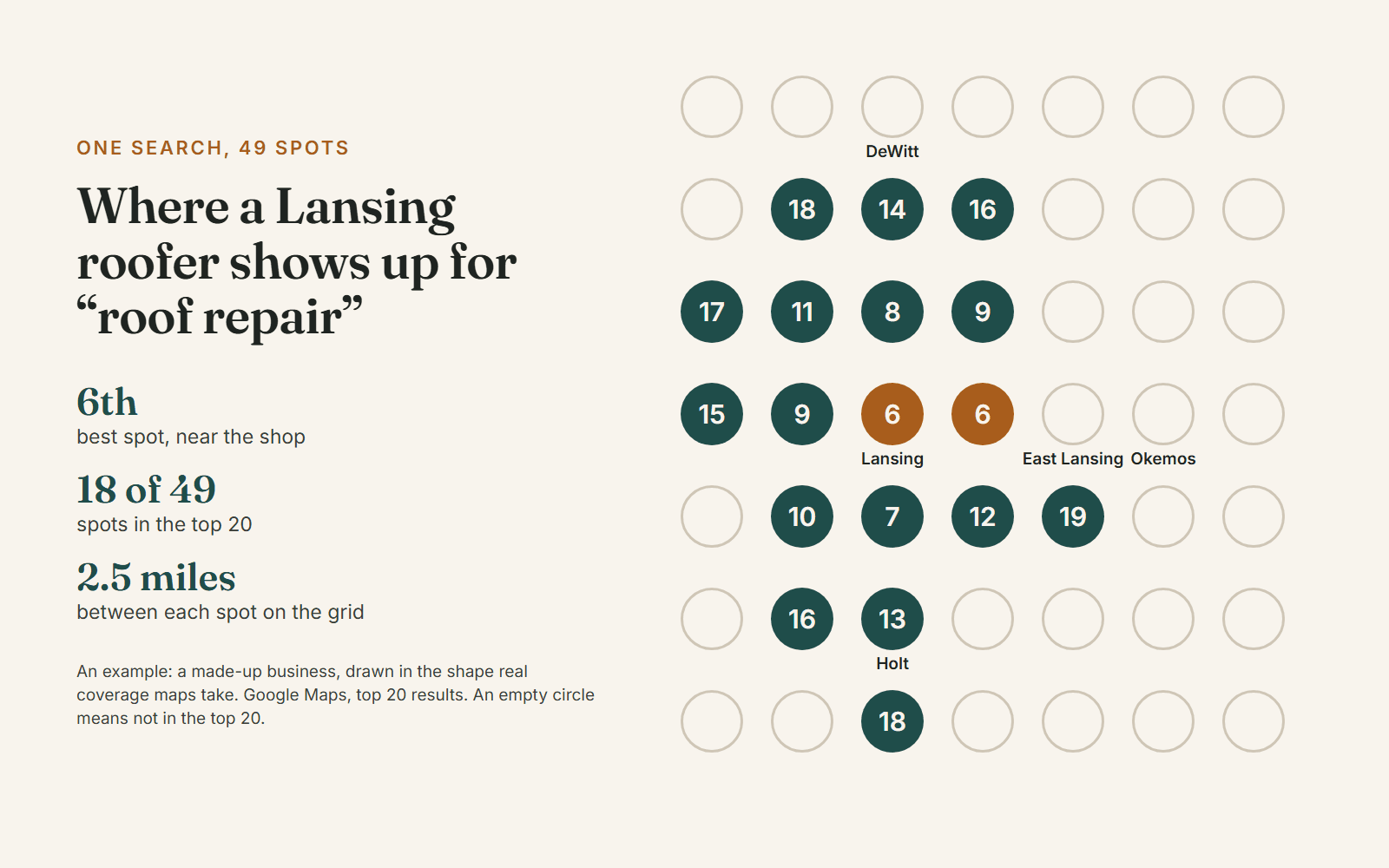
This roofer is made up, but the shape is the one these maps take when you run them for real. Near the shop, it comes up 6th. Move south and west, into the neighborhoods and Holt, and it hangs on in the top 20. Go a few miles east, into East Lansing and Okemos, and it's gone. Same north toward DeWitt. Across the whole grid, it makes the top 20 at 18 of the 49 spots.
First place moves around too. On one 49-spot grid we ran around Lansing this fall, 15 different businesses held first place somewhere on it. Every one of them could fairly say they rank first in the Lansing area. Each one is right, from where it was standing.
Why the list keeps changing
Google says it plainly: "Local results are mainly based on relevance, distance, and popularity." (opens in a new tab)
- Relevance is how well your business matches the words someone typed.
- Distance is how far you are from that person. Google's description: "how far each business is from the customer who's searching."
- Prominence is how well known your business is, which Google bases on things like reviews and the websites that link to you.
Two of those you can work on. The third is set by your customer's phone. Someone standing in Okemos and someone standing in Grand Ledge are asking the same question and getting different answers, and that's the map working the way it was built.
Why it looks fine from your desk
When you search for your own business from your own office, you're sitting in the best seat in the house. You're looking from the spot where distance helps you most. It feels like your ranking. It's really your ranking from that chair.
Take the roofer on the map. From his desk he sees himself 6th, on the first screen, and figures that's where he stands. A homeowner in Okemos with a leak over the kitchen types the same words, and he isn't in the top 20. Both results are real. Only one of them is the phone that was about to call somebody.
So the useful question changes. "What's my ranking?" has as many answers as there are places to stand. "Where do my customers find me, and where don't they?" has one, and you can put it on a map.
What moves the edges
You can't change where your customer is standing, and no business shows up everywhere. What you can do is push the edge of your map outward, particularly toward the towns where the work is.
- Be exact about what you do. Choose the categories and services on your Google Business Profile that match the words customers use. A profile that clearly says "roof repair" has a better shot at that search than one that only says "contractor."
- Keep your reviews coming. Google says "more reviews and positive ratings can help your business's local ranking." A review that names the job and the town also gives the next customer something real to read.
- Give the towns you serve a real page. Write about the work you've done there and the questions people there ask. Our page for web design in Lansing names the towns around it for this reason.
- Keep your details the same everywhere. Your name, phone and address should match on your profile, your website and the directories. Google says businesses with "complete and accurate info" are more likely to show up.
- Earn local links. The chamber, a supplier, a sponsor page, a local news story. Google counts how many websites link to you as part of prominence.
One thing you can skip: paying for it. Google says, "There's no way to request or pay for a better local ranking on Google." Ads are a separate thing and they're labeled as ads. These results have to be earned.
For more on the basics underneath all of this, start with why your website isn't showing up.
The same map matters for AI answers
When someone asks an AI assistant for "a good roofer in Okemos," the assistant often looks at the same public information: your listings, your reviews and what your website says about where you work. A site that states the towns it serves in plain words gives those tools something clear to repeat. That's a big part of what AI search optimization means for a local business: getting found, and getting described correctly, in the places you actually work.
Find out where you stand
You can get a rough picture this week. Next time you're on a job in another town, open Google Maps on your phone and search for what you do. Ask a customer or a friend across town to do the same and send you a screenshot. Write down where you land in five or six towns that matter to you.
For the full picture, a coverage map runs the search from every spot on a grid, like the one above. It's part of how we track search visibility, and it shows you which towns to work on first. If you'd like to see yours, let's talk.