
If people hire you, and not only your company, you need a personal brand website: a site about you, in your own voice, where people land after they meet you somewhere else. Your business site sells the business. Yours lets people get to know the person they'd be working with, and that's often what they came to find out.
Two sites, two jobs
A company website answers what does this business do? A personal brand website answers who is this person, and do I want to work with them?
Those are different questions, and one site rarely answers both well. Put your whole story on the company site and it starts to read like a résumé. Leave it off and the people looking for you find a staff photo and two lines of bio.
The two sites help each other. Each points to the other, and each does its own job.
Who comes looking
Once your name is known for something, different people come looking for different reasons:
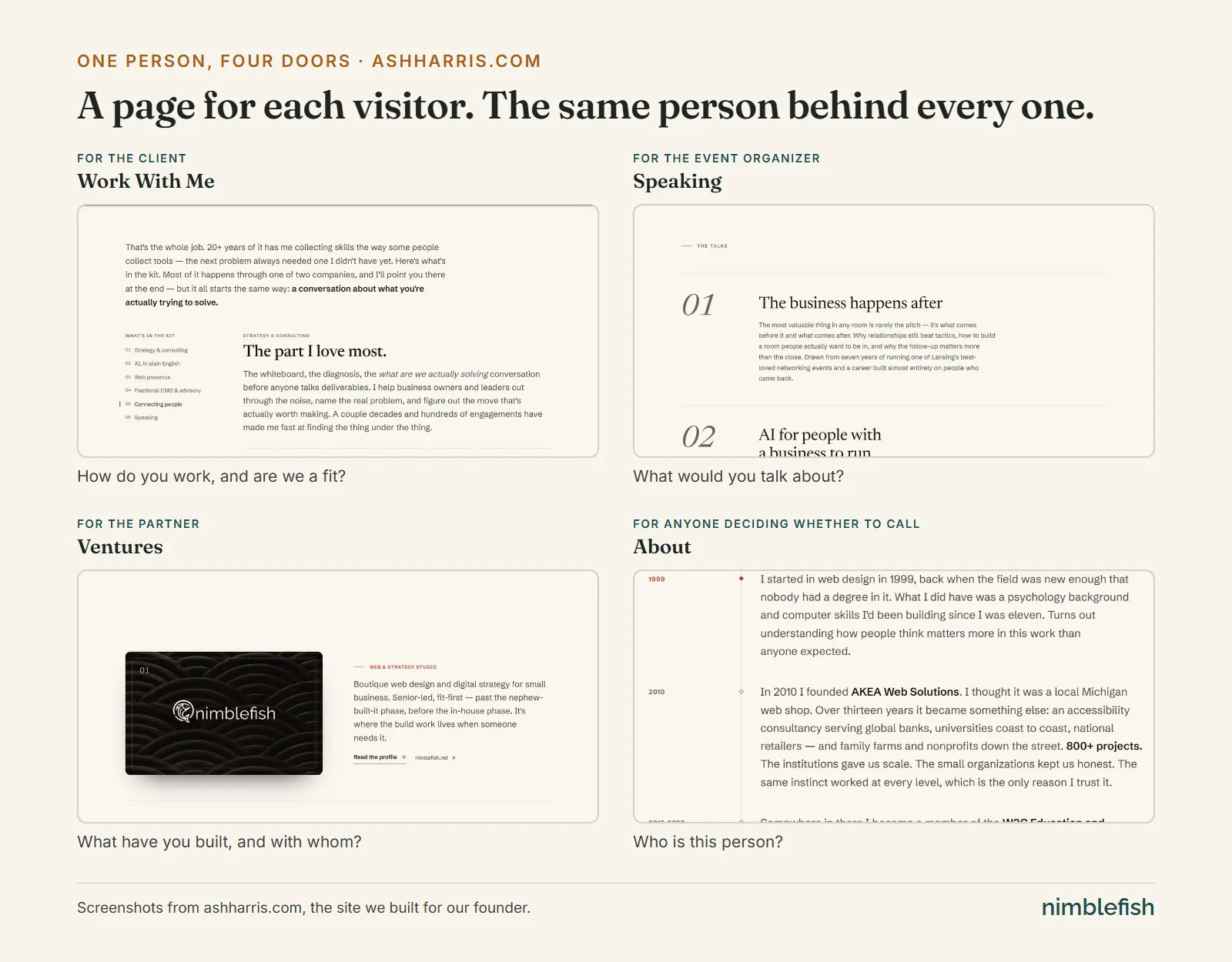
- A potential client wants to know how you work and whether you'd be a fit.
- An event organizer wants to know what you'd talk about and what the room would take home. That's a speaker website, inside your own.
- A potential partner wants to see what you've built and who you've built it with.
- Someone deciding whether to call wants your story, and a sense of the person behind it.
A good personal brand website gives each of them a door of their own: a page that answers their question, which they can share on its own. The same person is on the other side of every one.
 (opens a larger, zoomable view)
Build the brand before the website
The usual order is a template, then words to fill it. For a personal brand, that's backwards.
Start with your voice: how you talk, what you'd never say, the stories that are yours. Get it written down in a guide. Then the colors, the messages, the pages and the words, in that order. The website comes last, and it's the easy part, because every decision has something to answer to.
That's also how to build a personal brand online that lasts. The site is its home, your social profiles point there, and everything you publish sounds like the same person.
What to put on a personal brand website
- Who you are, what you do and for whom, in your words, near the top.
- A page for each kind of visitor, so nobody has to dig.
- The record behind you: the work, the talks, the companies, the years.
- Your voice, kept consistent, from the first page to the newest post.
- An easy way to reach you, from every page.
- Writing that keeps it current. A personal brand that goes quiet fades.
Keep it talking
A launch is a start. Articles written from the same voice guide, published on a steady schedule, keep the site current and give people a reason to come back. Each one gets its own share image and posts, so the social profiles keep pointing home.
How we did it for our founder
We built this for Ash Harris, who founded nimblefish. He's a strategist, a speaker, a studio founder and a partner in several companies, so his site at ashharris.com needed a door for each of the people who come looking. It started with hours of voice sessions, and the only thing carried over from before was his handwritten signature.
The full story, with the five decisions that shaped it: One person. Many doors.
If people hire you, your name deserves its own front door. If you'd like help building yours, let's talk.