
To get recommended by ChatGPT and other AI assistants, make it unmistakable what you specialize in, for whom and where, and say it the same way everywhere they read: your website, your Google Business Profile, your directory listings and your reviews. Assistants recommend the business that's clearly the right fit for the question. "We do it all" rarely is.
How an assistant picks
When someone asks who's the best roofer for a metal roof near Lansing?, the assistant isn't browsing. It's matching the question to what it can find and trust about the businesses that might fit.
The more specific the question, the more the answer favors whoever is plainly about that thing. A roofer whose site has a page on metal roofs, a gallery of metal roofs and reviews that say "metal roof" is an easy match. A roofer whose site says "residential and commercial roofing, siding, gutters, windows and more" might be just as good. The assistant has less to go on.
In our own research, asking assistants who to hire for one industry or another, the answers named businesses that serve that one thing, over and over. People ask specific questions, and the specific business wins them.
What it looks like
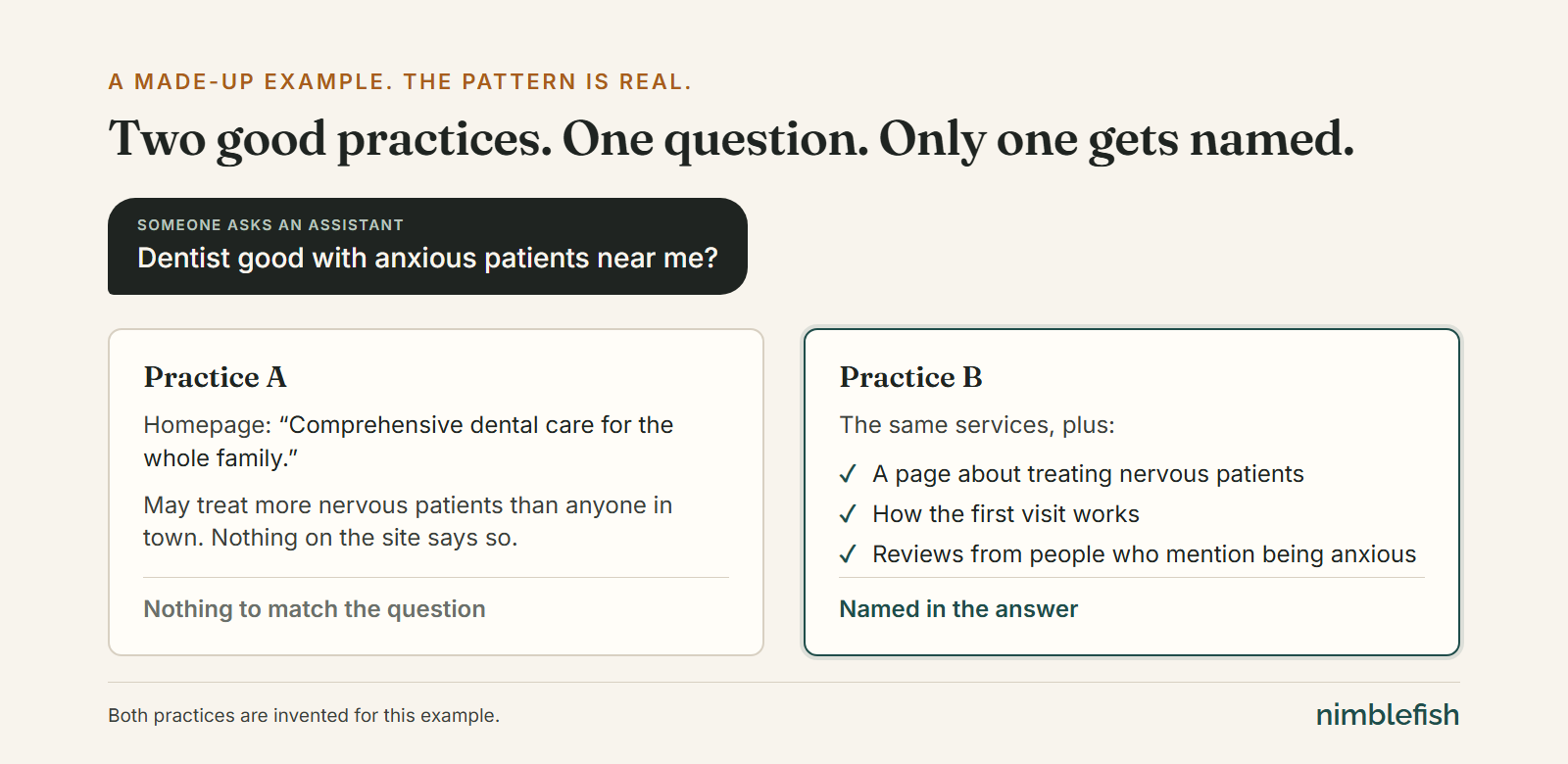
Picture two dental practices in the same town. They're made up; the pattern is real.
Both are excellent. The first says on its homepage that it offers "comprehensive dental care for the whole family." The second has the same services, plus a page about treating nervous patients, with how the first visit works, what they do differently, and a few reviews from people who mention being anxious.
Someone types dentist good with anxious patients near me into an assistant. The second practice gets named. The first practice may treat more nervous patients than anyone in town. Nothing tells the assistant so.
 (opens a larger, zoomable view)
Specialist doesn't mean doing less
You don't have to stop doing anything. Most businesses already have a specialty, or several. They just describe themselves broadly because it feels safer.
Being a specialist, to an assistant, means each thing you're best at is written down clearly enough to be matched to a question. That can be one specialty or five. What matters is that each one has a place of its own.
Where your specialty has to show
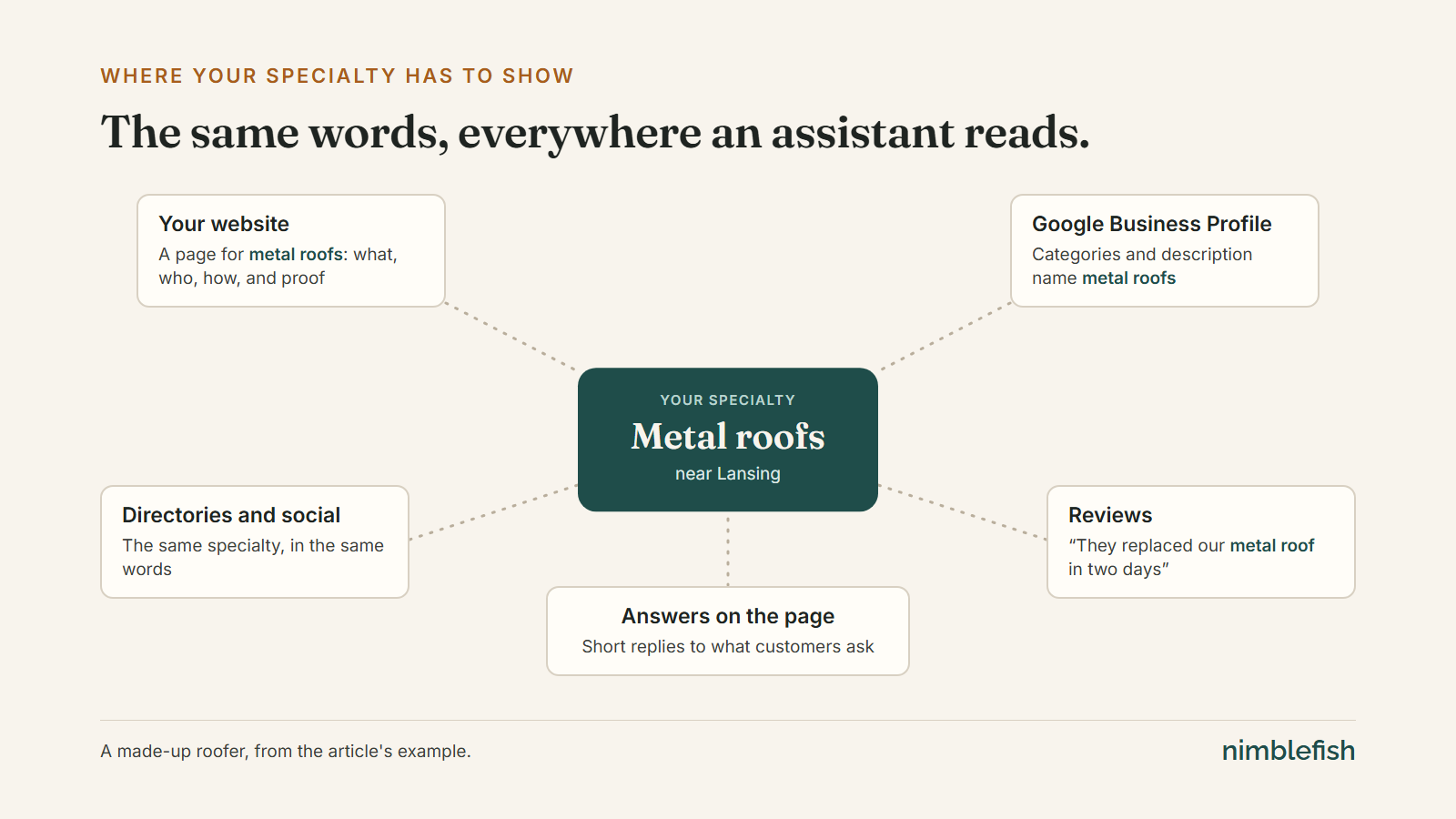
- A page for each specialty, in plain words: what it is, who it's for, how it works, and proof (photos, a short example, a review that mentions it).
- The same words everywhere. Your Google Business Profile's categories and description, your directory listings and your social profiles should name the same specialties your site does.
- Reviews that say what you did. "Great job" helps. "They replaced our metal roof in two days" helps more. When you ask for a review, it's fine to remind a happy customer what the job was.
- Your area, named. The towns you serve, written out, on the pages where they matter.
- Answers to real questions. Short, direct answers to what customers ask, on the page about that service. Assistants quote answers.
- Nothing out of date. Assistants read old pages too. We wrote about that in ChatGPT is quoting prices you stopped charging.
 (opens a larger, zoomable view)
Start with your best three
Pick the three jobs you most want more of, the ones you're best at and that pay best. For each, ask: if someone typed exactly that into an assistant, is there one page on my site that answers it? Does my Google profile say it? Do any reviews mention it?
Wherever the answer is no, that's your list. Start with the job you'd most like the phone to ring for.
This is most of AI search
People call this SEO for AI, answer engine optimization and half a dozen other names. Underneath the names, most of it is this: say clearly what you do best, for whom and where, in every place an assistant reads, and keep it current.
It's the center of our AI search optimization work, alongside the technical side assistants also need. If you'd like help working out which of your specialties to lead with, let's talk.